A free, self-paced deep dive into modern Databricks identity architecture โ Automatic Identity Management (AIM), legacy SCIM provisioning, Privileged Identity Management (PIM), nested-group inheritance, identity-divergence troubleshooting, and secretless Unity Catalog storage via Terraform. Built directly from the current Databricks IAM documentation and June 2026 Data + AI Summit platform announcements.
This course is built from a current Databricks IAM study handbook, an architecture infographic, and a production Terraform blueprint โ cross-checked against Databricks' own June 2026 Data + AI Summit announcements. It is not an official Databricks certification course; see the FAQ for what "SME" actually refers to.
AIM replaces a scheduled push model with an on-demand pull model, resolving most of SCIM's structural limitations:
Understand how identity operates as first-party on Azure vs. account-level federation on AWS and GCP, including AWS Unified Login and GCP's BYO-IDP shift.
Explain the Entra ID Graph API pull model, its 5/40-minute cache windows, and the nested-group API/Terraform visibility limit.
Use the AIM Enablement Prep Script's 3-phase audit to resolve externalId mismatches via the SCIM PATCH API.
Enable frictionless sharing of Apps, Genie Rooms, and AI/BI Dashboards to unprovisioned IdP users.
Enforce time-bound, audited elevation for Account/Metastore Admin roles, and mitigate sync-latency windows.
Provision Unity Catalog storage access via Azure Managed Identities in Terraform โ zero secrets, zero manual rotation.
The two tables every architect on this course should be able to reproduce from memory.
| Feature | SCIM Provisioning | Automatic Identity Management (AIM) |
|---|---|---|
| Sync Targets | Users and Groups (direct members only) | Users, Groups, and Service Principals |
| Nested Group Support | No โ direct memberships only | Yes โ transitive memberships supported |
| Entra ID App Requirement | Requires a separate Enterprise Application | No separate application required |
| Default Availability | Manual configuration | On by default for accounts created after Aug 1, 2025 |
| Identity Federation | Required | Required |
| Identity Status | Technical Definition / Trigger |
|---|---|
| Inactive: No Usage | Exists in the IdP but has never logged into Databricks (Users/SPs), or has not been added to a workspace (Groups). |
| Active | Has successfully authenticated or been actively provisioned into the Databricks environment. |
| Active: Removed From IdP | Was active but has been deleted in the IdP; will deactivate in Databricks on the next sync cycle. |
| Deactivated | Explicitly deactivated in the IdP, or automatically deactivated by Databricks following an IdP deletion. |
| Denied | On the account access denylist โ logins blocked, and the principal is excluded from sharing dialogs. |
A one-page visual summary of everything covered in the modules below: AIM vs. SCIM architecture, the SCIM deprovisioning lifecycle, the PIM & JIT lifecycle, multi-cloud identity integration, and troubleshooting identity divergence. Worth bookmarking as a quick-reference sheet while you work through the course.
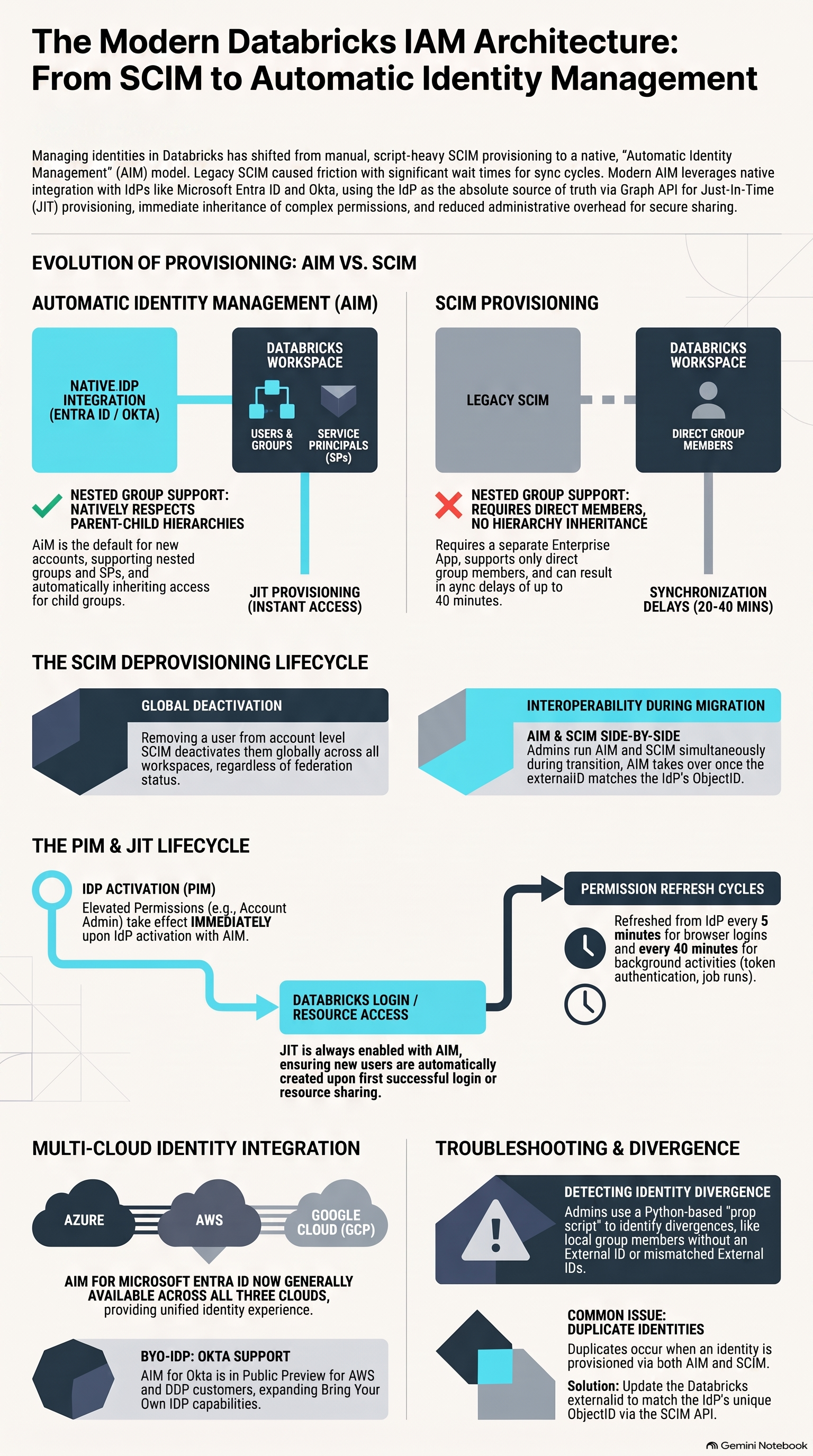
Five modules in a progressive build order โ cloud differences, sync mechanics, troubleshooting, provisioning boundaries, and PIM โ each with a practice quiz drawn from the 25 sourced scenario questions.
Workforce identity behaves differently on each cloud. Azure Databricks treats Entra ID as a first-party, deeply-integrated source of record. AWS and GCP require more explicit configuration to reach the same experience.
The "secretless" strategic recommendation applies across every cloud: Azure Managed Identities or AWS IAM Role Assumption โ never long-lived service principal keys.
Click an option to reveal whether it's correct.
AIM's General Availability removes the barrier of pre-provisioning entirely. Under AIM, you can share Unity Catalog objects or AI/BI dashboards with any user in your Entra ID directory โ the platform searches the whole IdP directory in real time, and the user is provisioned automatically on first access.
Note the 2026 behavior change: the default workspace "users" system group will have no entitlements โ workspace entitlements must be granted explicitly when adding principals, rather than inherited by default.
Click an option to reveal whether it's correct.
Identity divergence occurs when the IdP's unique ID (ObjectID) and the Databricks externalId fall out of sync โ typically surfacing as duplicate entries in sharing modals. Treat this as a pre-migration governance audit requirement.
| Error | Technical Meaning | Action to Take |
|---|---|---|
EXTERNAL_ID_NOT_IN_IDP | externalId does not exist in the IdP | Update to a valid ObjectID, or remove it |
EXTERNAL_ID_MATCH_NAME_MISMATCH | Correct ID, but the username differs | Users/SPs: update username (support ticket). Groups: rename group. |
NAME_MATCH_EXTERNAL_ID_MISMATCH | Name matches the IdP, but the ID is wrong | Update the Databricks externalId to the IdP's ObjectID |
GROUP_HAS_LOCAL_MEMBERS... | Group contains manually-added local members | Remove local members to restore the IdP as source of truth |
Renaming a group in the IdP is not proactive โ the change only reflects in Databricks once an administrator opens that group's detail page in the Account Console. Also note: removing an externalId (setting it empty) is currently supported for Groups only.
Click an option to reveal whether it's correct.
SSO-based JIT provisioning enables frictionless sharing of Databricks Apps, Genie Rooms, and AI/BI Dashboards to unprovisioned IdP users โ while SCIM remains active as a fallback deprovisioning channel to handle hard deletes and credential deactivation.
CBI allows administrators to enforce dynamic, zero-trust policies that restrict user access to sensitive platform layers, while safely exposing specific data apps, AI/BI dashboards, and Genie endpoints to unprovisioned external users โ without exposing the full workspace UI.
Workspace-level assets require the admin to first add the group to the workspace; account-level assets can be shared with any Entra ID group directly, since AIM searches the whole directory on demand.
Click an option to reveal whether it's correct.
For sensitive roles like Account Admin, enforce "Least Privilege" via Microsoft Entra ID Privileged Identity Management (PIM), using Entra ID P2 or Governance licenses to grant time-bound, audited group role activation.
PIM activation in the Azure portal is instant for Azure RBAC. But because Databricks relies on its own internal sync cycles, there's a known delay of up to 40 minutes before the elevated group membership is recognized inside Databricks under legacy SCIM โ advise users to activate PIM roughly 45 minutes before performing sensitive operations if SCIM is still in use. AIM's 5-minute browser-login cache window shortens this dramatically.
PIM is designed for human users โ it does not support Service Principals. Success always depends on the AIM sync cycle actually recognizing the dynamic group membership update.
Click an option to reveal whether it's correct.
Worked scenarios showing the mechanics above applied to real production incidents.
A platform administrator activates their "Metastore Admin" group role via Azure PIM. Immediately after, they hit a Permission Denied error trying to configure Unity Catalog storage credentials โ because the organization's SCIM connector only syncs every 20โ40 minutes, while Entra ID updated instantly.
SCIM is a push model on a scheduled interval; it has no idea the PIM activation happened until its next sync cycle runs. AIM instead uses direct Microsoft Graph API queries triggered by authentication checks โ group memberships refresh dynamically based on activity (5 min for browser logins, 40 min for token/job auth).
Decommission the legacy SCIM connector via Security โ User Provisioning in the Account Console. Register the PIM-managed group in Databricks with its Entra ID ObjectId as the externalId. Once activated, a fresh browser login lets AIM query Graph API within its 5-minute cache window โ privileges resolve almost instantly.
An architect builds Marketing-All (parent, explicitly provisioned) with nested children Marketing-US and Marketing-EU. A nightly audit script queries the SCIM API for members of Marketing-US and gets an empty result or 404 โ even though those users are actively working in the workspace.
AIM grants access transitively without pre-provisioning the entire hierarchy, to avoid account-limit bloat in tenants with deep nesting. Because the child groups were never directly provisioned, they're visible in the Account Console UI but cannot be retrieved, searched, or managed via the SCIM API or Terraform.
If only access inheritance is needed, nothing changes โ permissions cascade transitively. To make a child group independently queryable, explicitly provision it as its own group shell via POST /api/2.1/accounts/<accountId>/scim/v2/Groups with its Entra ID ObjectId set as the externalId.
A 10,000-user organization migrates from a legacy SCIM connector to AIM. Admins notice duplicate identities in sharing modals, new Entra ID groups sharing names with legacy local groups failing to sync, and dashboard-share member counts not matching the actual member list.
AIM relies on the provisioned identity's externalId matching the IdP's ObjectId. Manually-created or outdated-SCIM-mapped identities may have a missing or mismatched externalId, so Databricks treats the local and IdP identities as two separate objects. Databricks also enforces a strict unique group-name constraint at the account level, which blocks provisioning when a legacy group already reserved that name.
Run the AIM Enablement Prep Script's divergence scan (an account-admin service principal executes run_divergence against config.py's ACCOUNT_ID). Triage NAME_MATCH_EXTERNAL_ID_MISMATCH entries via SCIM PATCH to correct the externalId, and triage GROUP_HAS_LOCAL_MEMBERS_WITHOUT_EXTERNAL_ID by removing local members and re-adding legitimate ones directly in Entra ID.
A complete, production-grade Terraform blueprint for onboarding ADLS Gen2 storage into Unity Catalog using Azure Managed Identities โ eliminating manual secret rotation entirely.
Hierarchical namespace enabled (is_hns_enabled = true) โ mandatory for Delta Lake directory-level transactional guarantees, with public access denied by default.
A System-Assigned Managed Identity โ the first-party, secretless cloud identity layer Databricks recommends for metadata connectivity.
Grants the Managed Identity "Storage Blob Data Contributor" scoped directly to the target storage account โ no keys, no client secrets.
Registers the Access Connector as a Storage Credential, then scopes it to a safe abfss:// path as an External Location.
Full blueprint (~230 lines) additionally covers: storage-account network firewall rules with IP/subnet allow-lists, the resource group and container provisioning, and Terraform outputs for the connector's principal ID and the registered External Location URL. Deploy with the standard lifecycle: terraform init โ terraform plan -out=tfplan โ terraform apply tfplan.
A rapid-recall deck spanning sync intervals, error diagnostics, provisioning rules, and multi-cloud identity patterns. Read the question, think of your answer, then flip the card to check yourself. Mark each card "Got It" or "Still Learning" to build a focused review queue.
Compiled from a Databricks IAM study handbook, an architecture infographic, a production Terraform blueprint, and current Databricks product announcements.
All 25 fully-sourced scenario questions from the course material, grouped exactly as they appear in the modules above. Click any option to reveal the answer and hint. (Two questions from the original 27-question bank โ #24 and #27 โ did not extract cleanly from the source document and are omitted rather than invented.)
Ten questions drawn from the module content above, spanning all five modules. Answer all correctly to unlock your certificate โ retry as many times as you like.
You have studied:
Score 10/10 on the quiz above to generate your personalized certificate below.
New Delhi, India ยท wdfuniverse.org
proudly presents this
This is to certify that
has successfully completed
Subject: Databricks Identity & Access Management
Course Module DIAMโ2026: AIM, SCIM & Unity Catalog Security
Topic: Automatic Identity Management, PIM, Identity Divergence Troubleshooting & Secretless Terraform
Course content compiled from a Databricks IAM study handbook, architecture infographic, and Terraform blueprint (2026)
Hosted by World Development Foundation (WDF) for the Global Community
No. Databricks Inc.'s official certifications are the Data Engineer Associate/Professional, Data Analyst Associate, ML Associate/Professional, Generative AI Engineer Associate, Context Engineering Associate, and Associate Developer for Apache Spark. "Subject Matter Expert" identity badges (e.g. via EdChart on Credly) are third-party credentials, not issued by Databricks. This course gives genuine technical depth on Databricks IAM โ content that also directly supports the Identity and Access domain of the official Azure Databricks Certified Associate Platform Administrator exam โ without misrepresenting its certification status.
No formal prerequisite, but familiarity with Unity Catalog fundamentals and basic Databricks administration will help the material land faster, especially in Modules 2 and 3.
Questions 24 and 27 did not extract cleanly from the source document โ their question text was missing even though the answer key listed answers for them. Rather than inventing plausible-sounding content to fill the gap, this course presents only the 25 questions with fully verified, sourced text.
The distinction between what AIM grants transitively (access) versus what it actually provisions (a queryable local object). Nested child groups get real access through inheritance, but stay invisible to the SCIM API and Terraform unless explicitly provisioned as their own group shell โ this exact pattern appears across several scenario questions.
No โ this is an independent, free study course compiled from a study handbook, an architecture infographic, and a Terraform blueprint, cross-checked against Databricks' public product announcements, for educational purposes only.