๐Ÿ“ง wdfuniverse@gmail.com ๐Ÿ“ž 91-11 45701632 ๐Ÿ“ Plot 5, Sector-3, Dwarka, New Delhi ๐Ÿ•™ 10:00โ€“18:00 Hrs.
๐ŸŽ“ Course โ€” Databricks Certified Data Engineer Associate: 2026 Edition ยท Free Online Lecture Series Data Ingestion ยท Transformation ยท Governance ยท Audio ยท Video ยท Text
W WDF UniverseKnowledge Agricultureยฎ ยท SDG 2030
Homeโ€บ Enroll Freeโ€บ Databricks Certified Data Engineer Associate
โ— Course DEAโ€‘2026 ยท Data Engineering Track

Databricks Certified
Data Engineer Associate

A free, self-paced prep course built entirely from the May 4, 2026 exam guide โ€” Unity Catalog governance, Auto Loader ingestion, Lakeflow Spark Declarative Pipelines, Lakeflow Jobs orchestration, CI/CD with Declarative Automation Bundles, and performance troubleshooting. Read the lessons, study the references, then sit a practice quiz and print your certificate.

45Scored Questions
90Minute Limit
7Exam Domains
2 yrCertification Validity
Hosted by WDF Universe ยท Course Faculty
Prof. Dr. Sir Hari Om Srivastava
President & CEO, World Development Foundation
Aprajita Srivastava
Hony. Director, World Development Foundation
catalog.schema.table Lakeflow SDP
Goldmaterialized views ยท BI
Silvercleansed ยท standardized
Bronzeraw ingestion
Course Details

Everything the May 2026 exam guide covers

This course mirrors the structure of the official Databricks exam guide, updated to reflect the 2026 terminology shift toward declarative, Unity Catalogโ€“governed data engineering.

Subject
Data Engineering with Databricks
Prerequisite
None โ€” 6 months hands-on recommended
Registration Fee
USD 200 + tax
Delivery
Online or Test Center
Test Aides
None allowed
Recertification
Every 2 years

โš  ALERT โ€” 2026 Terminology Shift

The rebrand is not cosmetic โ€” it signals the platform's move from imperative "how-to" scripting to declarative "whatโ€‘is" systems engineering. Learn the new names before you sit the exam:

Delta Live Tables (DLT)
โ†’
Lakeflow Spark Declarative Pipelines (SDP)
Databricks Asset Bundles (DABs)
โ†’
Declarative Automation Bundles
Databricks Repos
โ†’
Databricks Git Folders
Databricks Workflows
โ†’
Lakeflow Jobs
Learning Objectives

After completing this course

๐Ÿ—๏ธ

Master the Lakehouse Platform

Understand Delta Lake, Unity Catalog, and how to pick between All-Purpose, Job, and Serverless compute for a given workload.

๐Ÿšš

Ingest at Any Scale

Prioritize between Auto Loader, COPY INTO, and Lakeflow Connect (standard & managed) based on volume, frequency and data type.

โš™๏ธ

Build Declarative Pipelines

Design Bronze/Silver/Gold pipelines with Streaming Tables, Materialized Views, Expectations, and the APPLY CHANGES INTO CDC API.

๐Ÿ”€

Orchestrate with Lakeflow Jobs

Configure DAG-based task graphs, retries, conditional branching, and choose between scheduled, file-arrival and table-update triggers.

๐Ÿš€

Ship with CI/CD

Package and promote code across dev/test/prod with Declarative Automation Bundles, databricks.yml, and the Databricks CLI.

๐Ÿฉบ

Diagnose & Govern

Spot data skew, shuffle, and disk spill in the Spark UI; apply Liquid Clustering, RLS, column masking, and ABAC in Unity Catalog.

Exam Outline ยท Weighted by Domain

7 domains, 45 scored questions

Domain weighting reflects the new structure effective May 4, 2026. Data Ingestion and Data Transformation together make up more than half of the exam โ€” study those modules first.

#DomainWeight
1Databricks Intelligence Platform6%
2Data Ingestion and Loading21%
3Data Transformation and Modeling22%
4Working with Lakeflow Jobs16%
5Implementing CI/CD10%
6Troubleshooting, Monitoring & Optimization10%
7Governance and Security15%
Lesson Content ยท Full Text

Course Modules โ€” MCโ€‘DEAโ€‘2026

Seven modules, one per exam domain. Click a module to expand the lesson. Every module ends with the exam-relevant syntax and a scenario tip.

Module 1Databricks Intelligence Platform6%๏ผ‹

The Data Lakehouse pairs the low-cost, flexible storage of a data lake with the ACID transactions and governance of a data warehouse. Delta Lake supplies the transactional storage layer; Unity Catalog supplies unified governance across data and AI assets.
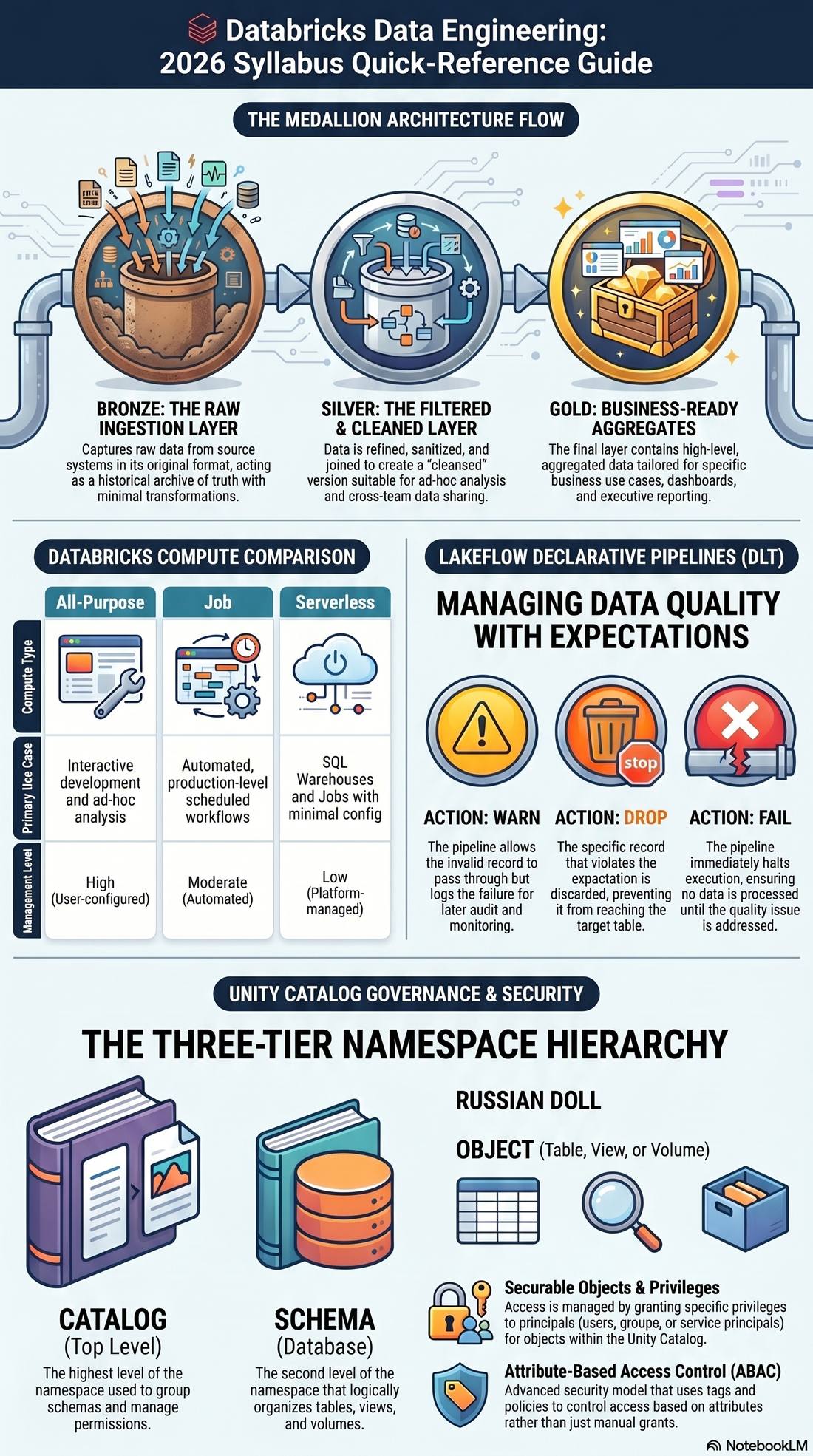
Databricks Data Engineering 2026 Syllabus Quick-Reference Guide โ€” Medallion flow, compute comparison, and Unity Catalog namespace
Fig. 1.1 โ€” Medallion flow, compute comparison, and the three-tier Unity Catalog namespace at a glance.

Compute services โ€” pick the right tool

All-Purpose ClusterInteractive development and ad-hoc analysis. High management overhead, user-configured.
Job ClusterAutomated, production-level scheduled workflows. Spins up, runs, and terminates โ€” cost-optimized.
SQL WarehouseServerless option for BI/SQL workloads with instant scaling and minimal configuration.
Serverless ComputeReduced configuration overhead across jobs and pipelines; platform-managed.

Control Plane vs. Data Plane

  • The Control Plane hosts the workspace UI, job scheduler, and notebook management.
  • The Data Plane is where compute clusters actually process your data.

Exam tip

"Automated production ETL that should terminate immediately after completion" โ†’ always points to a Job Cluster, not All-Purpose.

Module 2Data Ingestion and Loading21%๏ผ‹

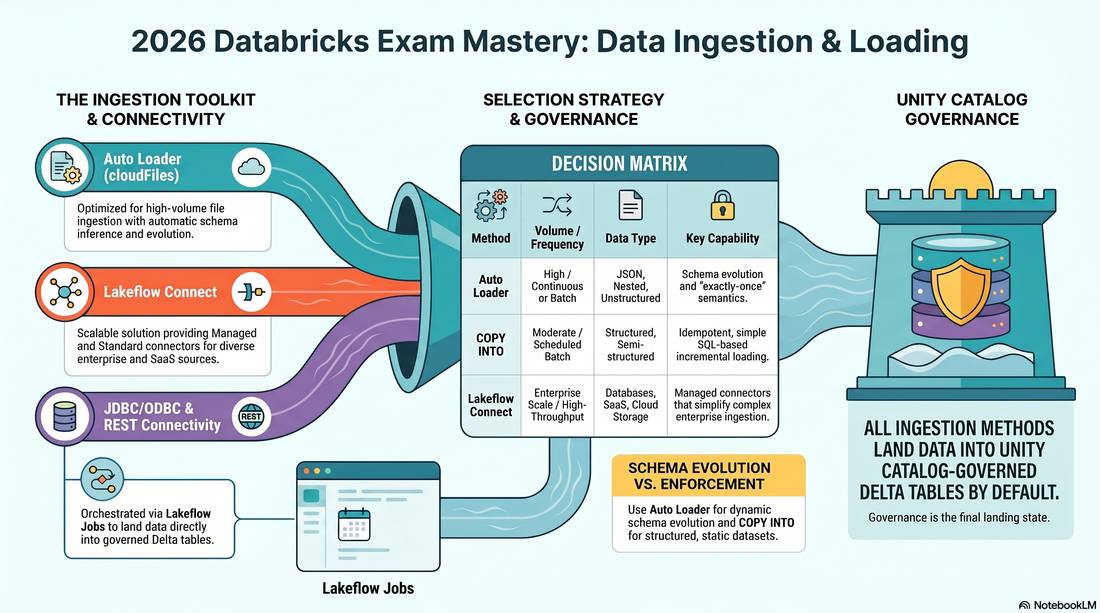
Three ingestion tools cover almost every scenario on the exam. All of them land data into Unity Catalogโ€“governed Delta tables by default.

2026 Databricks Exam Mastery: Data Ingestion & Loading โ€” toolkit, decision matrix, and Unity Catalog governance
Fig. 2.1 โ€” Ingestion toolkit, selection decision matrix, and the Unity Catalog governance landing zone.
Auto Loader (cloudFiles)High-volume / continuous file ingestion with automatic schema inference and evolution. Handles billions of files with exactly-once semantics via checkpointing.
COPY INTOIdempotent, SQL-based incremental loading of moderate, scheduled batches of structured/semi-structured files.
Lakeflow ConnectManaged connectors for enterprise SaaS & database sources (Salesforce, SQL Server); Standard connectors for cloud object storage.
JDBC / ODBC / RESTUsed in notebooks for custom sources, usually orchestrated and scheduled with Lakeflow Jobs.

Auto Loader file-detection modes

  • Directory Listing (default, polling-based) โ€” fine for smaller file sets, slows down at scale.
  • File Notification (event-based, via cloud SQS/SNS or Event Grid) โ€” the recommended mode once a landing zone reaches millions of files.

Handling malformed records

Auto Loader automatically routes rows that don't match the target schema into a _rescued_data column instead of dropping them โ€” this prevents silent data loss during schema drift.

Selection matrix

MethodVolume / FrequencyBest For
Auto LoaderHigh / continuousJSON, nested, unstructured data
COPY INTOModerate / scheduled batchStructured, static file sets
Lakeflow ConnectEnterprise scaleSaaS & database sources

Exam tip

"Billions of files, exactly-once semantics" is Databricks' own description of Auto Loader โ€” memorize that phrase.

Module 3Data Transformation and Modeling22%๏ผ‹

This is the single largest domain โ€” it covers the Medallion Architecture, PySpark/SQL cleaning, Lakeflow Spark Declarative Pipelines (SDP) dataset types, data quality Expectations, and Change Data Capture.
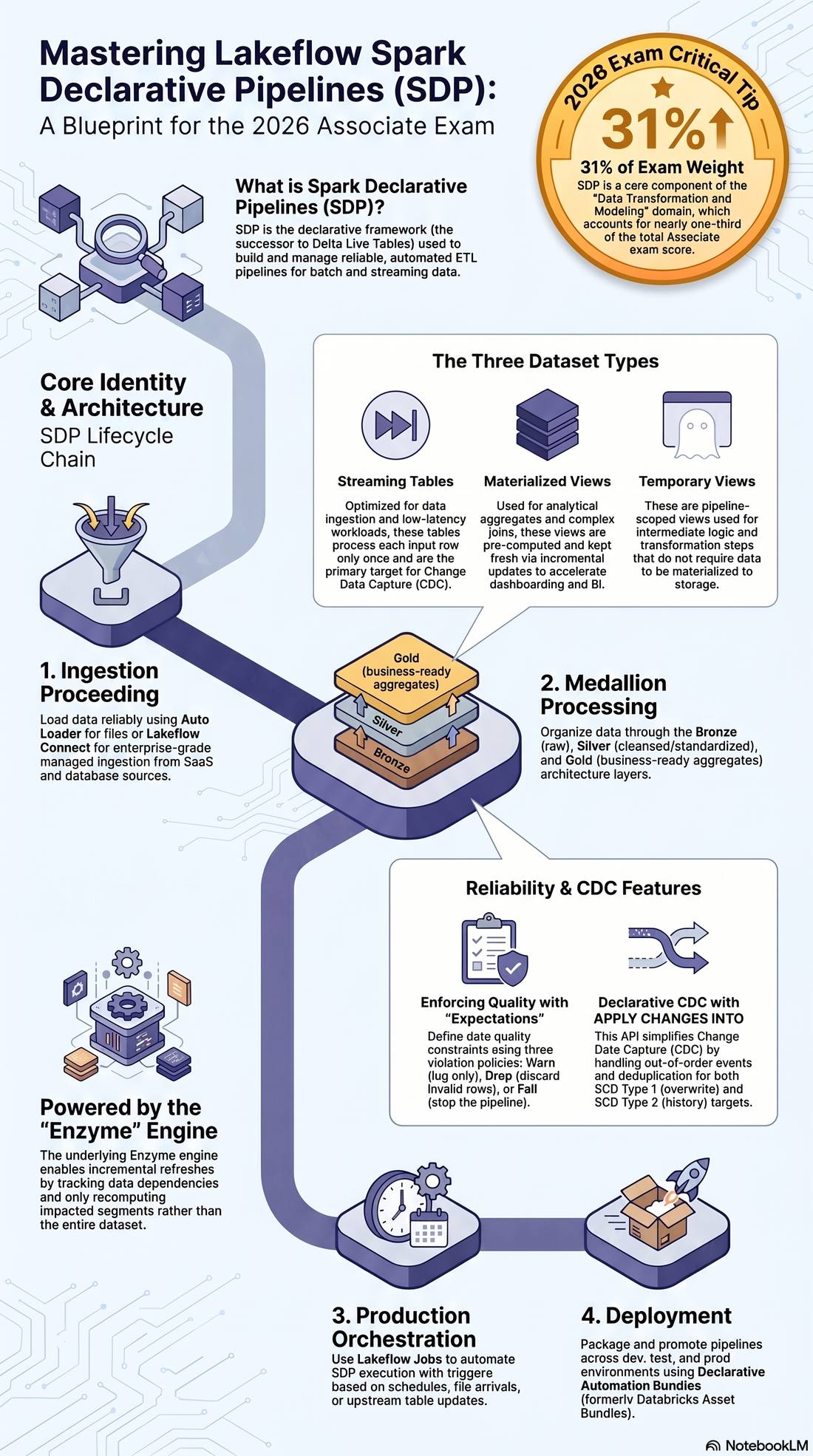
Mastering Lakeflow Spark Declarative Pipelines (SDP) โ€” blueprint for the 2026 Associate exam
Fig. 3.1 โ€” SDP lifecycle chain: ingestion โ†’ Medallion processing โ†’ production orchestration โ†’ deployment, powered by the Enzyme engine.

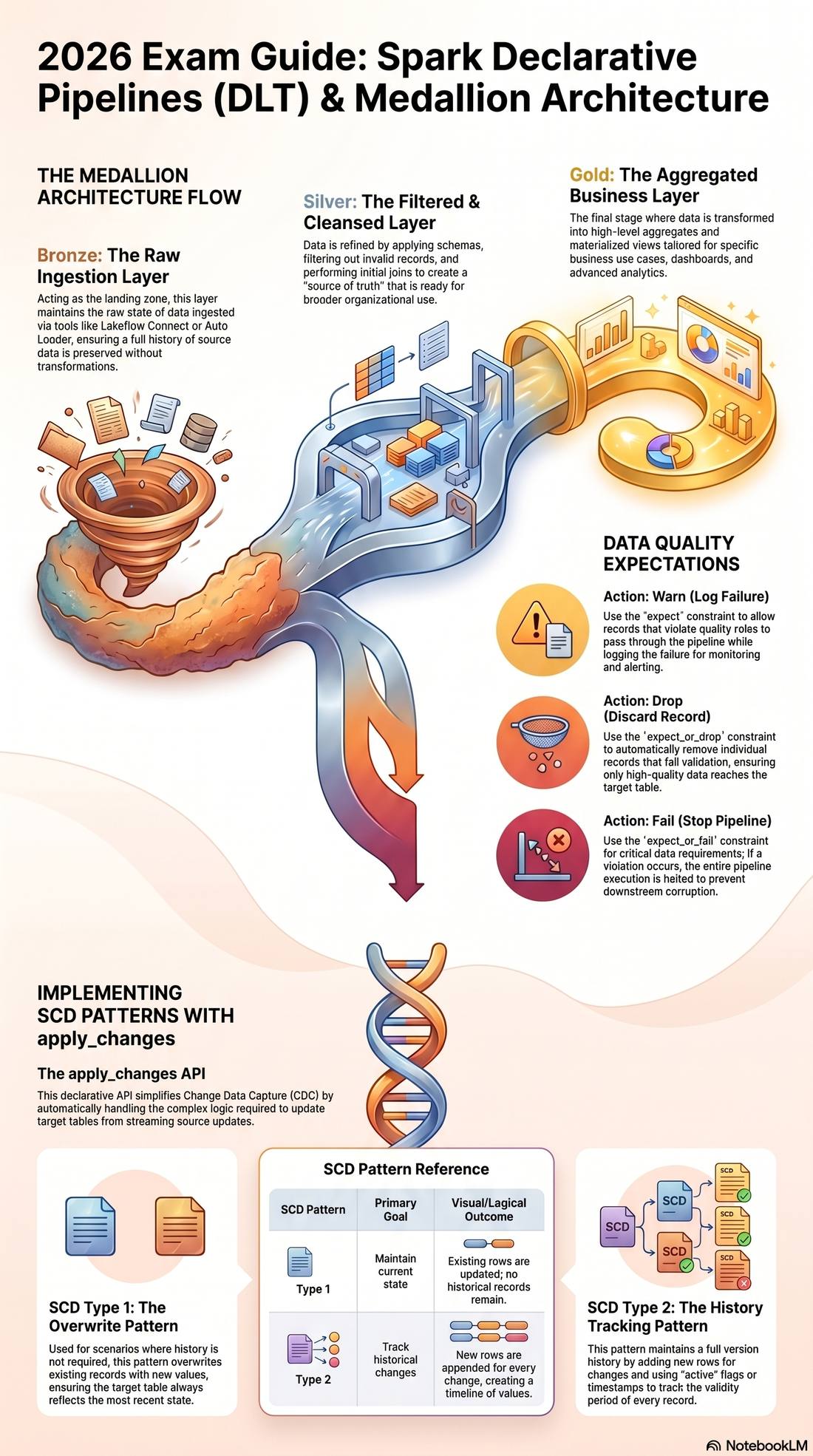
The Medallion Architecture

๐Ÿฅ‰ Bronze โ€” Raw IngestionHistorical archive of source data in original format, minimal transformation.
๐Ÿฅˆ Silver โ€” CleansedNulls cleaned, types standardized, joins applied โ€” a "source of truth" for broad reuse.
๐Ÿฅ‡ Gold โ€” Business-ReadyHigh-level, pre-computed aggregates tailored for dashboards, BI and executive reporting.
2026 Exam Guide: Spark Declarative Pipelines (DLT) and Medallion Architecture โ€” Bronze, Silver, Gold with SCD patterns
Fig. 3.2 โ€” Bronze โ†’ Silver โ†’ Gold flow with Expectations (Warn / Drop / Fail) and the SCD Type 1 vs. Type 2 pattern reference.

Three SDP dataset types

Streaming TablesAppend-only, process each row once. Primary target for Bronze ingestion and CDC.
Materialized ViewsPre-computed, incrementally refreshed. Used for Gold-layer analytical aggregates and dashboard acceleration.
Temporary ViewsEphemeral, memory-only, pipeline-scoped โ€” used for intermediate logic that never needs to be materialized.

Data quality with Expectations

Expectations are true/false SQL constraints applied to every row. Three violation policies:

WARN โ€” log only, keep the row DROP โ€” discard the invalid row FAIL โ€” halt the pipeline
CONSTRAINT valid_id EXPECT (id IS NOT NULL) -- warn CONSTRAINT valid_id EXPECT (id IS NOT NULL) ON VIOLATION DROP ROW -- drop CONSTRAINT valid_id EXPECT (id IS NOT NULL) ON VIOLATION FAIL UPDATE -- fail

Quarantine pattern: run two flows from the same source โ€” a main flow with DROP, and a mirrored flow with the inverse condition writing to a dedicated quarantine table, so bad data is investigated, not lost.

CDC with APPLY CHANGES INTO

Replaces manual MERGE INTO logic. Handles out-of-order events and deduplication automatically using a Sequencing Key (typically a timestamp or version column).

SCD Type 1Overwrites existing rows โ€” no history retained, only current state.
SCD Type 2Appends a new row per change, preserving a full version timeline.

The Enzyme engine

Powers incremental recomputation in SDP: it builds a dependency graph and recomputes only the impacted segments of data rather than rescanning everything โ€” append-only sources are cheapest, windowed aggregations rewrite only affected partitions.
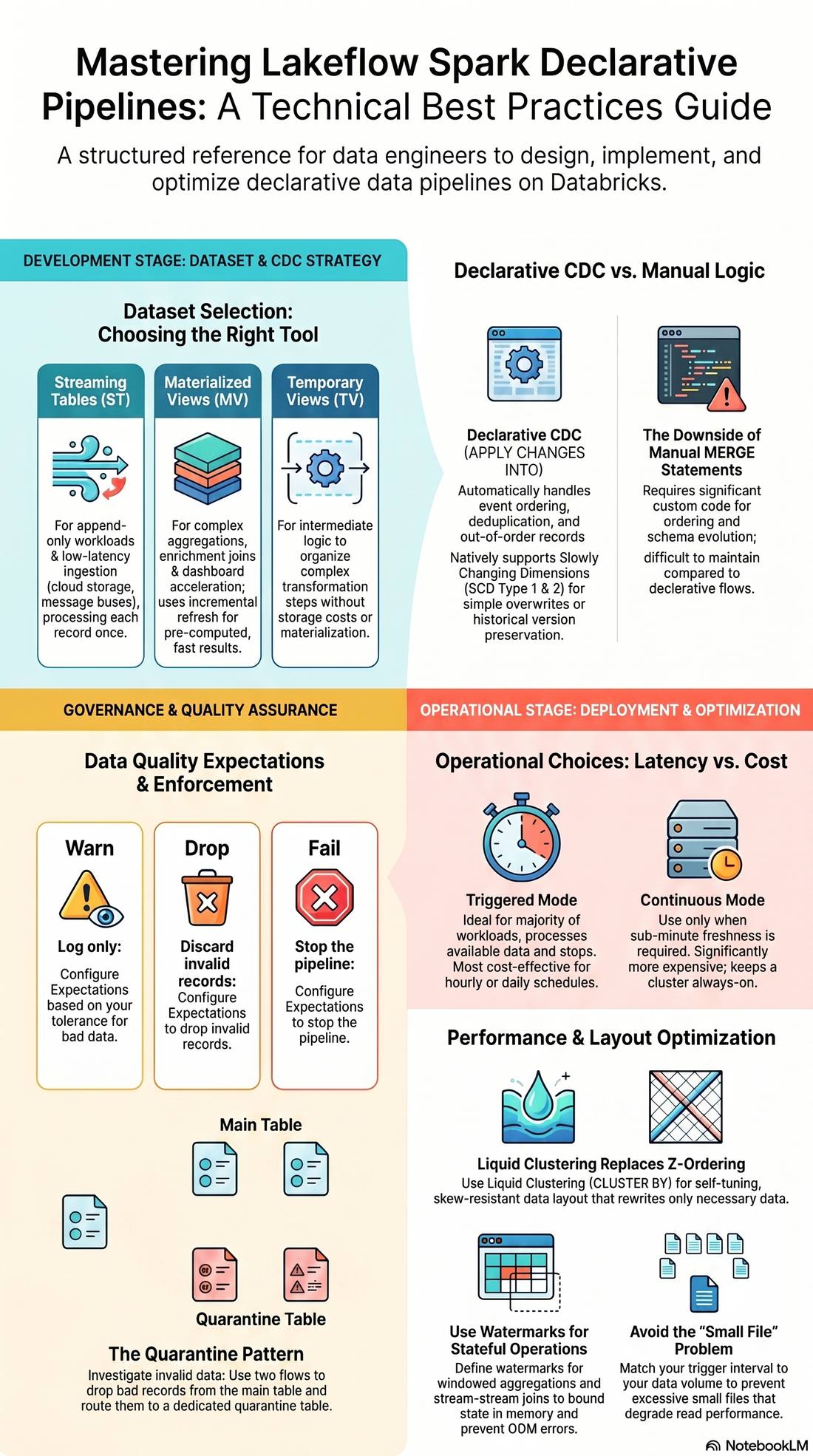
Mastering Lakeflow Spark Declarative Pipelines: A Technical Best Practices Guide โ€” dataset selection, CDC, quality, and optimization
Fig. 3.3 โ€” Best-practices reference: dataset selection, declarative CDC vs. manual MERGE, quarantine pattern, and liquid clustering.

Lazy evaluation โ€” the classic "gotcha"

Transformations (.filter(), .select(), .groupBy(), .join()) are lazy โ€” Spark only records them in a DAG. Nothing executes until an Action (.count(), .show(), .collect(), .save()) is called.

df = spark.read.table("bronze_data") df_filtered = df.filter(df.status == "Active") df_grouped = df_filtered.groupBy("region").count() # โ†‘ nothing has executed yet โ€” no Action was called

Exam tip

If a code block ends on a transformation with no Action, the correct answer is always "nothing happens โ€” Spark uses lazy evaluation." Always check the last line first.

Module 4Working with Lakeflow Jobs16%๏ผ‹

Lakeflow Jobs (formerly Databricks Workflows) orchestrate notebooks, SQL queries, dashboards, and SDP pipelines using a DAG-based task graph with dependencies, retries, and conditional branching.
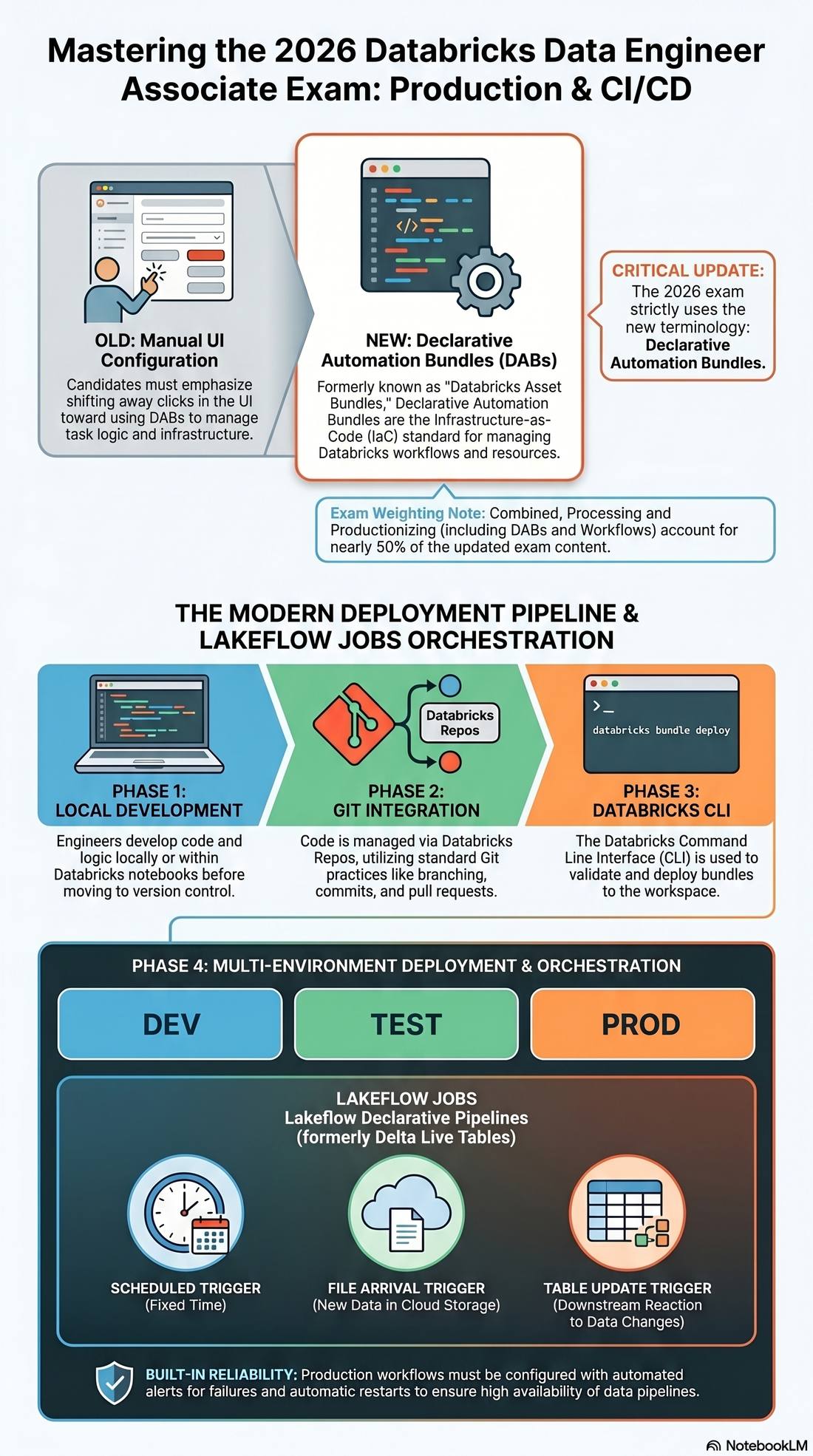
Mastering the 2026 Databricks Data Engineer Associate Exam: Production & CI/CD โ€” deployment pipeline and Lakeflow Jobs orchestration
Fig. 4.1 โ€” Deployment pipeline phases and the three Lakeflow Jobs trigger types: Scheduled, File Arrival, Table Update.

Trigger types

Scheduled (Cron)Fixed-time execution โ€” the default for predictable, low-cost batch runs.
File ArrivalFires as soon as new data lands in cloud storage โ€” ideal for event-driven ingestion.
Table UpdateTriggers downstream jobs automatically when an upstream table changes โ€” used for reactive, data-driven pipelines.

Repair and Rerun

For complex DAGs, this feature re-executes only the specific task-level segments that failed, instead of restarting the entire job from scratch โ€” the core answer to any "minimize downtime after partial failure" scenario.

Built-in reliability

Production workflows must be configured with automated failure alerts and automatic restarts to guarantee high availability of data pipelines.

Module 5Implementing CI/CD10%๏ผ‹

Candidates must shift away from clicking through the UI toward code-first, version-controlled deployment using Declarative Automation Bundles (DABs) โ€” the Infrastructure-as-Code standard for Databricks (formerly Databricks Asset Bundles).
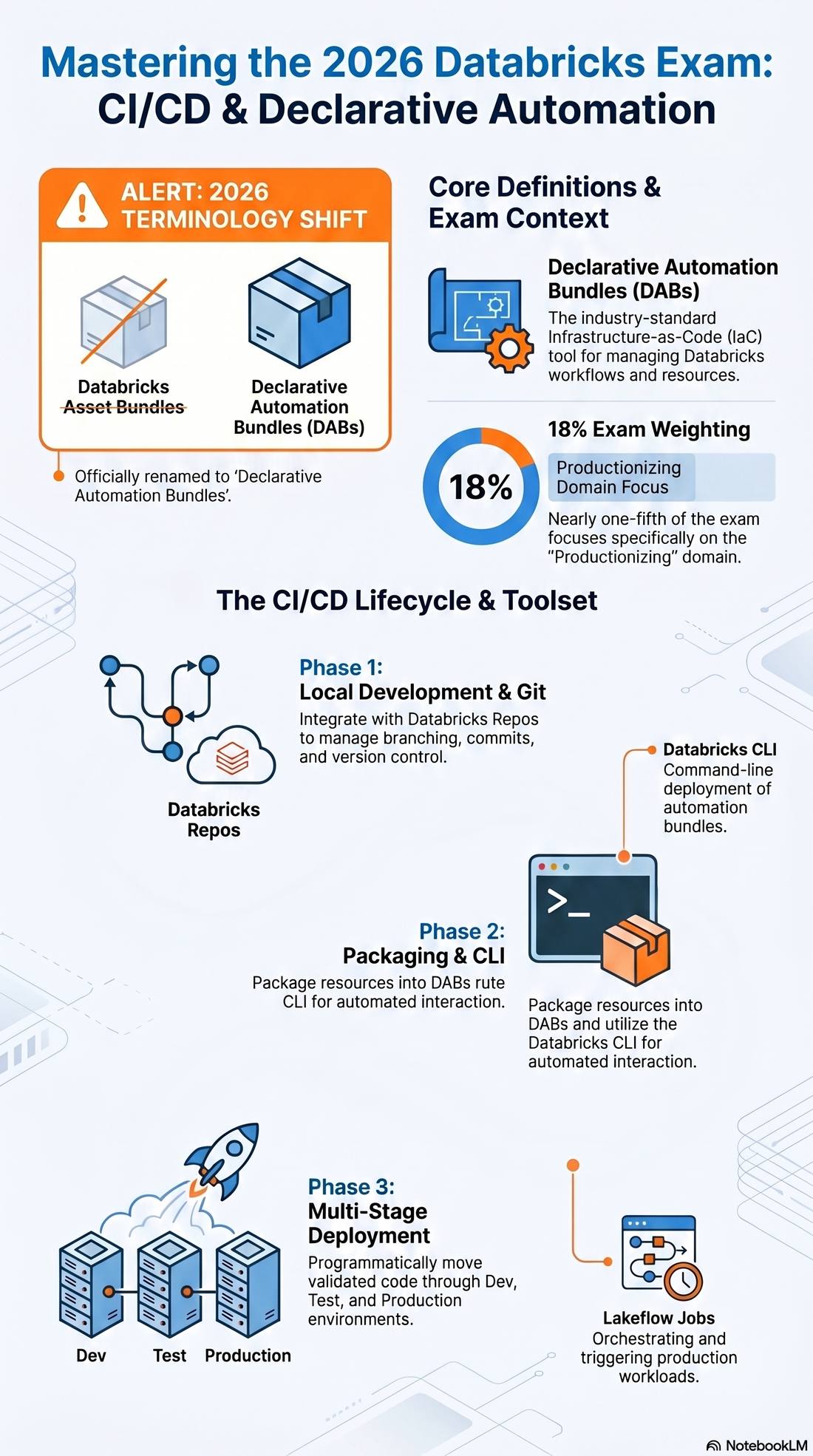
Mastering the 2026 Databricks Exam: CI/CD & Declarative Automation โ€” terminology shift and the CI/CD lifecycle toolset
Fig. 5.1 โ€” The 2026 terminology shift (DABs โ†’ Declarative Automation Bundles) and the three-phase CI/CD lifecycle.

The deployment pipeline

Phase 1 โ€” Local DevelopmentEngineers write code locally or in Databricks notebooks before moving to version control.
Phase 2 โ€” Git IntegrationCode is managed via Databricks Git Folders using standard branching, commits, and pull requests.
Phase 3 โ€” Packaging & CLIResources are packaged as a bundle; the Databricks CLI validates and deploys it to a target workspace.
Phase 4 โ€” Multi-Environment DeploymentThe same codebase is promoted across Dev โ†’ Test โ†’ Prod using environment-specific variable overrides โ€” no code changes required.

Key files & commands

databricks.yml โ€” root bundle config databricks bundle validate databricks bundle deploy

Exam tip

"Move code from a dev catalog to a prod catalog without changing source code" โ†’ always environment-specific variables and overrides in the bundle configuration, never hardcoded catalog names.

Module 6Troubleshooting, Monitoring & Optimization10%๏ผ‹
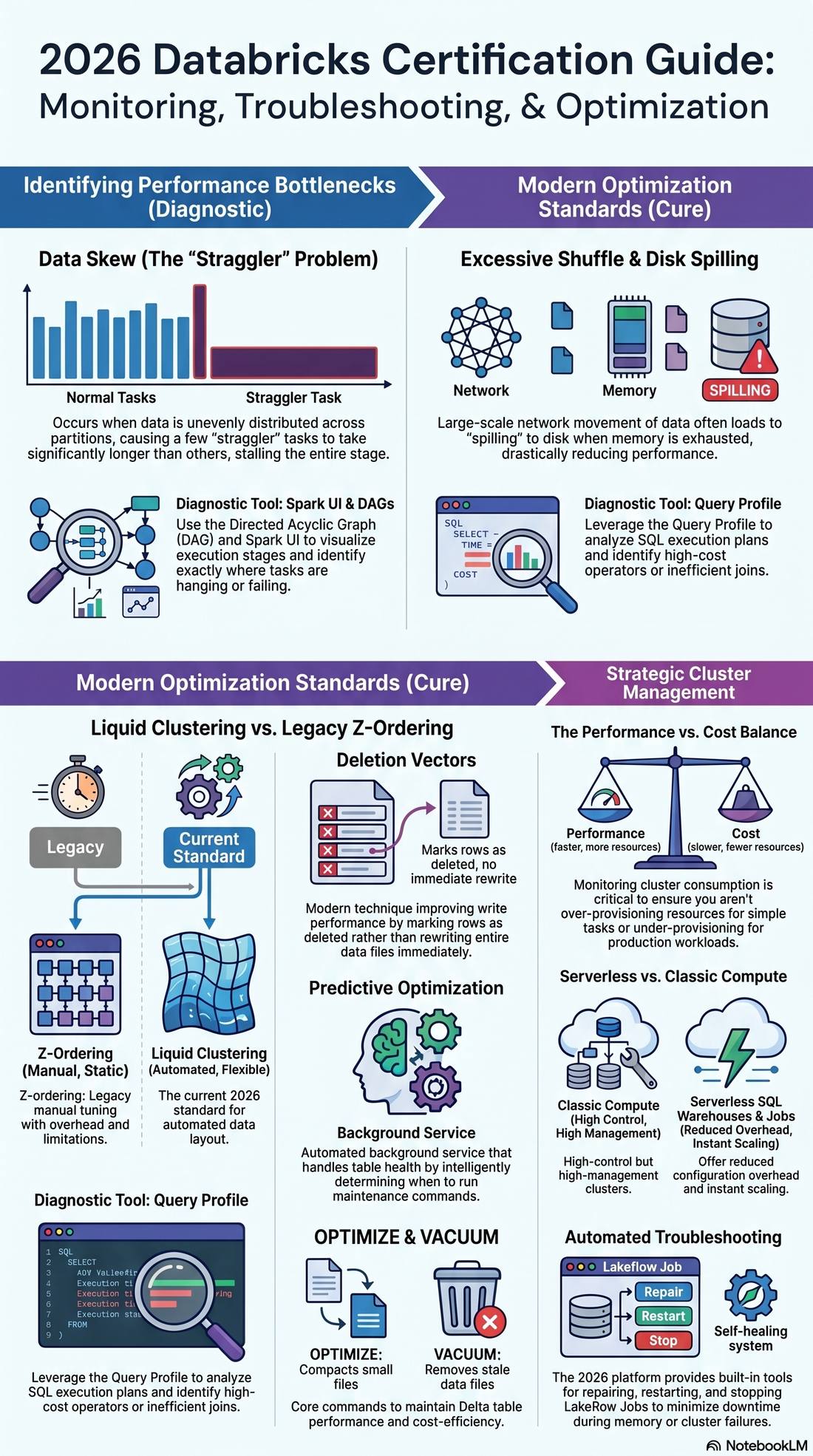
2026 Databricks Certification Guide: Monitoring, Troubleshooting & Optimization โ€” diagnostics and modern optimization standards
Fig. 6.1 โ€” Diagnosing bottlenecks with Spark UI/Query Profile, then curing them with Liquid Clustering and Predictive Optimization.

The "Big Three" bottlenecks (Spark UI)

Data SkewOne "straggler" task takes far longer than the rest โ€” data unevenly distributed across partitions.
Shuffle OverheadLarge-scale network movement of data during complex joins/aggregations.
Disk SpillingA partition exceeds executor memory, forcing Spark to write intermediate data to disk โ€” drastically slower than in-memory processing.

Modern optimization standards

  • Liquid Clustering replaces legacy manual Z-Ordering / static partitioning โ€” a self-tuning, Hilbert-curve-based layout that adapts to changing query patterns without expensive rewrites.
  • Predictive Optimization is an autonomous background service that runs OPTIMIZE and VACUUM on Unity Catalog managed tables based on cost-benefit analysis, and captures statistics "on write."
  • Deletion Vectors mark rows as deleted without an immediate rewrite, improving write performance.
  • Fix skew in-flight with salting โ€” append a random bucket suffix to skewed keys before grouping.
  • Avoid a small-shuffle join cost with a broadcast join hint when one table is small.

Diagnostic & observability tools
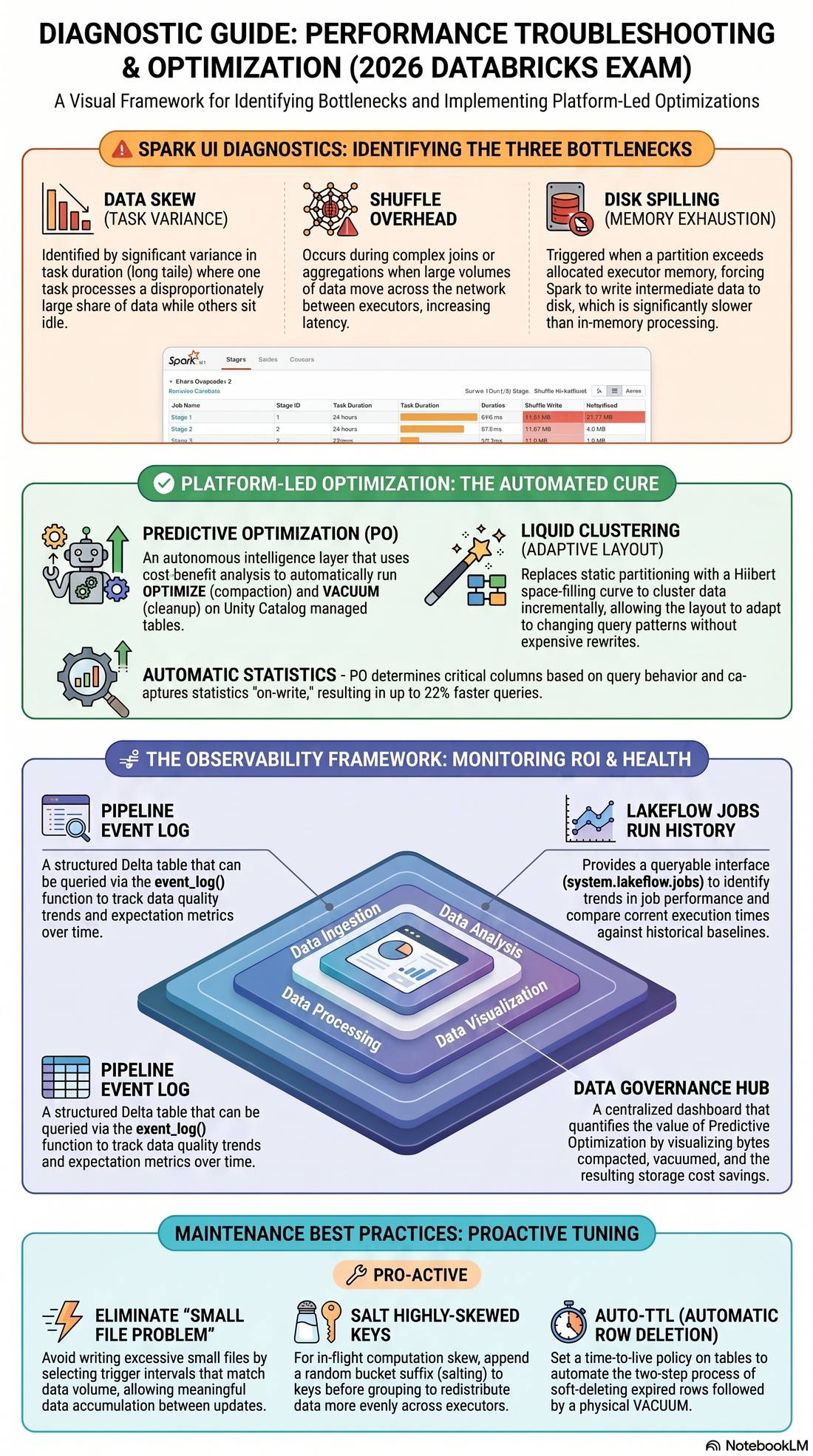
Spark UI & DAGs Query Profile Pipeline Event Log โ€” event_log() system.lakeflow.jobs system.billing.usage
Diagnostic Guide: Performance Troubleshooting & Optimization for the 2026 Databricks Exam
Fig. 6.2 โ€” Spark UI diagnostics for the three bottlenecks, platform-led automated cures, and the observability framework.

Exam tip

"One task takes 45 minutes while others finish in 10 seconds" is the textbook description of data skew, not shuffle overhead or spilling.

Module 7Governance and Security15%๏ผ‹
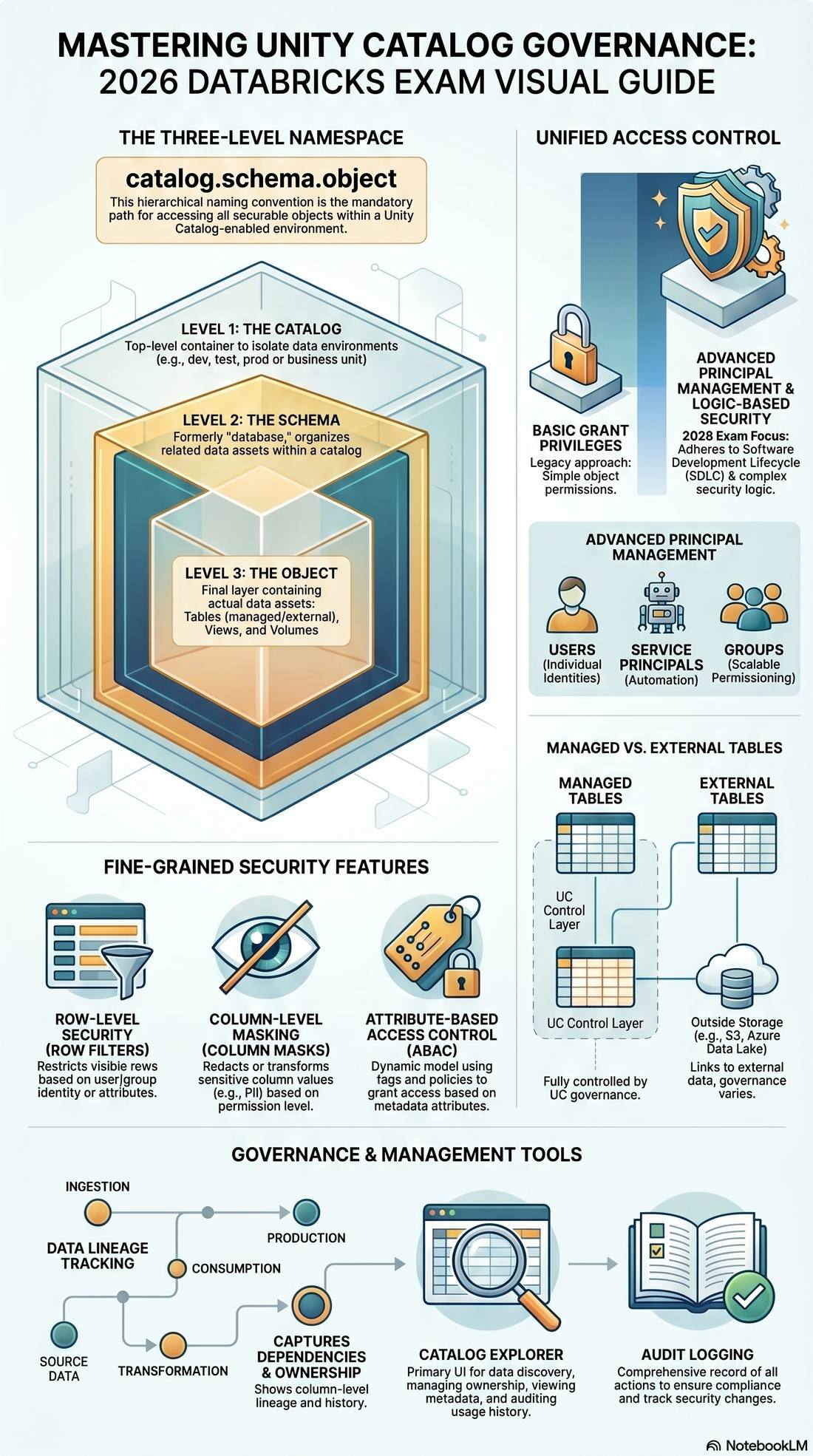
Mastering Unity Catalog Governance โ€” 2026 Databricks Exam Visual Guide: namespace, access control, and fine-grained security
Fig. 7.1 โ€” The three-level namespace, unified access control, and fine-grained security features (RLS, column masking, ABAC).

The three-level namespace

catalog.schema.table

CatalogTop-level container to isolate environments (dev, test, prod) or business units.
SchemaFormerly "database" โ€” logically organizes tables, views, and volumes within a catalog.
ObjectThe leaf level: tables (managed/external), views, and volumes.

Managed vs. external tables

FeatureManaged TableExternal Table
Data file ownershipUnity CatalogUser / external system
Storage locationManaged root storageUser-specified (S3/ADLS/GCS)
DROP TABLE resultDeletes metadata + data filesDeletes metadata only

Core privileges (GRANT / REVOKE / DENY)

USAGE โ€” required to browse a catalog/schema SELECT โ€” read-only access MODIFY โ€” INSERT / UPDATE / DELETE / MERGE CREATE โ€” new objects
GRANT SELECT ON SCHEMA catalog_name.schema_name TO `analysts_group`; REVOKE MODIFY ON TABLE transactions FROM sp_migration_service; DENY SELECT ON TABLE hr_payroll TO contractor_group; -- DENY always wins

Exam pro-tip: a principal needs USAGE on both the parent catalog and the parent schema to access an object โ€” a common cause of "why can't this user see the table" scenarios.

Fine-grained security

Row-Level SecurityRestricts visible rows using row filters based on user/group identity.
Column-Level MaskingRedacts or transforms sensitive PII columns depending on the caller's permission level.
Attribute-Based Access Control (ABAC)Uses tags and policies to control access dynamically across the catalog, replacing thousands of manual grants.

Observability

Data Lineage traces column-level flow from ingestion to consumption for impact analysis; Audit Logging (system.access.audit) captures every governed action; Delta Sharing extends live data to non-Databricks consumers like Power BI or Snowflake.

Academic & Technical Bibliography

References & Further Reading

This course was compiled directly from the official Databricks exam guide and supporting technical study material.

01
Databricks Certified Data Engineer Associate โ€” Exam GuideDatabricks, Inc. Exam version as of May 4, 2026. Official domain outline, sample questions, and answer key.
02
Technical Analysis: Lakeflow Spark Declarative Pipelines for 2026 Certification PrepDomain-structure comparison, rebranding map, dataset-type deep dive, Enzyme engine, and DAB CLI workflow.
03
Auto Loader & Lazy Evaluation โ€” Further ReadingFile detection modes, rescued-data columns, transformations vs. actions, and "gotcha" question patterns.
04
Unity Catalog Governance & Permission Hierarchy โ€” 2026 Technical ReferenceThree-level namespace, managed vs. external table lifecycle, GRANT/REVOKE/DENY syntax, RLS, column masking, ABAC.
05
Mastering Lakeflow Spark Declarative Pipelines (SDP)Streaming Tables, Materialized Views, Temporary Views, Expectations, and the quarantine pattern for data quality.
06
CI/CD & Declarative Automation Bundles Study GuideLocal development โ†’ Git integration โ†’ CLI packaging โ†’ multi-environment deployment lifecycle.
07
Performance Optimization Diagnostic GuideData skew, shuffle overhead, disk spilling, Liquid Clustering, Predictive Optimization, and system tables for observability.
08
Practice Question Banks (Exams 1โ€“3)105 retired-style multiple-choice questions spanning all seven domains, with answer keys, used to build the quiz below.
Lesson Assessment ยท Qualify for Certificate

Practice Quiz โ€” Databricks Data Engineer Associate

Ten questions drawn from the module content above, spanning all seven domains. Answer all correctly to unlock your certificate โ€” you can retry as many times as you like.

You have studied:

  • Ingestion (Auto Loader, COPY INTO, Lakeflow Connect)
  • Medallion architecture & Lakeflow SDP dataset types
  • Governance, CI/CD, and troubleshooting fundamentals
Certificate of Completion

Print Your Certificate

Score 10/10 on the quiz above to generate your personalized certificate below.

WDF Universe ยท World Development Foundation

New Delhi, India ยท wdfuniverse.org
proudly presents this

Certificate of Course Completion

This is to certify that

โ€” your name โ€”

has successfully completed

Subject: Data Engineering with Databricks
Course Module DEAโ€‘2026: Databricks Certified Data Engineer Associate
Topic: Ingestion, Transformation, Lakeflow Jobs, CI/CD, Troubleshooting & Governance

Quiz Score: โ€” / 10

Course content compiled from the official Databricks exam guide, version May 4, 2026
Hosted by World Development Foundation (WDF) for the Global Community

Prof. Dr. Sir Hari Om SrivastavaKStJ ยท D.Litt ยท Ph.D ยท Scientist
President & CEO, World Development Foundation
Aprajita SrivastavaHony. Director, World Development Foundation, New Delhi
Course Code: DEAโ€‘2026โ€‘MC001
Date of Issue: โ€”
Quick Reference

Frequently Asked Questions

What changed in the May 2026 exam update?

The exam moved from a 5-domain to a 7-domain structure, split "Data Processing" into Ingestion (21%) and Transformation (22%), and added dedicated CI/CD (10%) and Troubleshooting (10%) domains. Terminology also shifted: DLT โ†’ Lakeflow Spark Declarative Pipelines, DABs โ†’ Declarative Automation Bundles, Repos โ†’ Git Folders, Workflows โ†’ Lakeflow Jobs.

Is Hive Metastore still tested?

No. Unity Catalog is the mandatory governance environment for every exam scenario as of the 2026 update; legacy Hive Metastore concepts are not assessed.

Which domain should I study first?

Data Transformation and Modeling (22%) and Data Ingestion and Loading (21%) together account for 43% of the exam โ€” start there, then move to Governance (15%) and Lakeflow Jobs (16%).

Do I need to memorize exact SQL syntax?

Yes for the high-frequency patterns: EXPECT / ON VIOLATION clauses, GRANT/REVOKE/DENY, COPY INTO, and MERGE INTO vs. APPLY CHANGES INTO. These appear repeatedly across the retired question banks used to build this course.

Is this course affiliated with Databricks?

No โ€” this is an independent, free study course compiled from the publicly available Databricks exam guide and supporting study notes, for exam preparation purposes only.